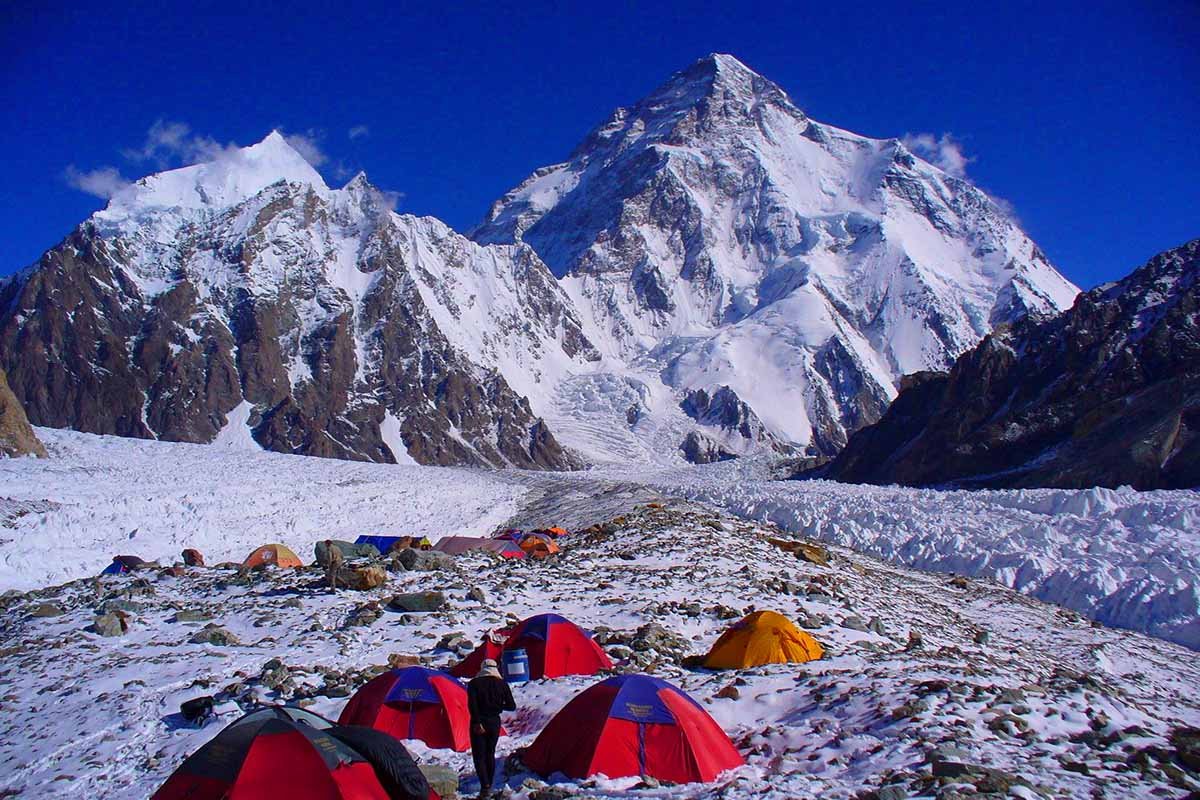
Climbing K2: The Abruzzi Spur Route, Camps, Season and How Long It Takes

By Riaz Ahmed Shigri, Logistics and Marketing Manager, Chogori Adventure, Skardu · Updated November 2026
How is K2 climbed?
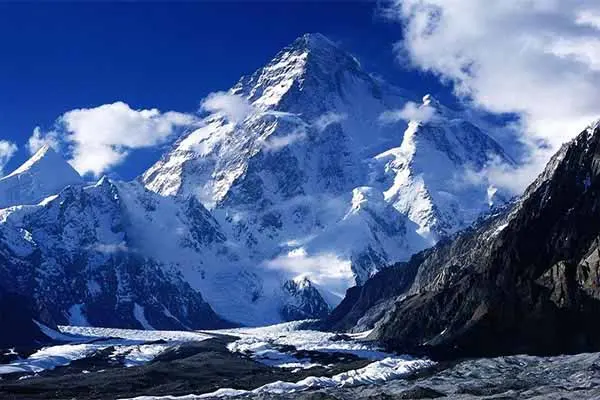
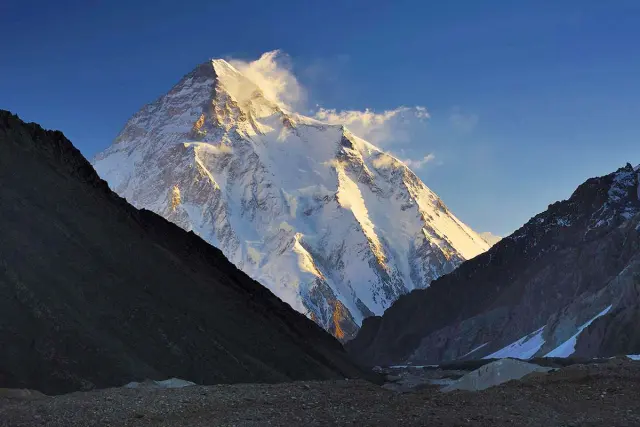
K2 (8,611 m) stands on the border of Pakistan and China and is almost always climbed from Pakistan, by the Abruzzi Spur, its south-east ridge. From K2 Base Camp (about 5,150 m) climbers use four high camps, at about 6,050 m, 6,700 m, 7,200 m and 7,800 m, before a long summit day through the Bottleneck. A summer expedition takes about 50 days from Islamabad back to Islamabad, about 25 of them on the mountain, and the summit window usually comes in the second half of July.
This guide explains the route section by section, how long the climb takes, when to go and how K2 compares with Everest. To join an expedition, see our K2 Climbing Expedition; for prices, read how much it costs to climb K2.
K2 at a glance
| Fact | |
|---|---|
| Height | 8,611 m (28,251 ft), the second-highest mountain on Earth |
| Where | Karakoram range, Gilgit-Baltistan, Pakistan, on the border with China |
| Normal route | The Abruzzi Spur (south-east ridge), used for about three in four summits |
| K2 Base Camp | About 5,150 m (16,896 ft), a day’s walk beyond Concordia (4,691 m) |
| High camps | About 6,050 m, 6,700 m, 7,200 m and 7,800 m (the Shoulder) |
| Best time | 20 June to 5 August; most summits in the second half of July |
| Expedition length | About 50 days from Islamabad; about 25 days on the mountain |
| First ascent | 31 July 1954, Lino Lacedelli and Achille Compagnoni (Italian expedition), by the Abruzzi Spur |
| First winter ascent | 16 January 2021, a team of ten Nepali climbers |
The Abruzzi Spur, section by section
The times below are typical for a fit, acclimatised climber. They change with the snow, the weather and how well the ropes are fixed. The exact place of each camp also moves a little from year to year.
| Section | Height | Typical time | What it is like |
|---|---|---|---|
| K2 Base Camp → Advanced Base Camp | 5,150 → about 5,600 m | 2–3 hours | A walk up the glacier and a short icefall, with some fixed rope. |
| Advanced Base Camp → Camp 1 | → about 6,050 m | 4–6 hours | Long snow and ice slopes with some rock; the first fixed ropes. |
| Camp 1 → Camp 2, with House’s Chimney | → about 6,700 m | 5–7 hours | Steeper mixed ground. House’s Chimney, a near-vertical rock crack of about 30 m just below Camp 2, is climbed on fixed ropes. |
| Camp 2 → Camp 3, over the Black Pyramid | → about 7,200 m | 2–4 hours | The most technical part: a long, steep rock buttress, with loose rock and rockfall. |
| Camp 3 → Camp 4, on the Shoulder | → about 7,800 m | About 3 hours | Snow slopes of about 40–50° up to the broad Shoulder. Avalanche risk after fresh snow. |
| Camp 4 → summit, through the Bottleneck | → 8,611 m | 10–16 hours up and down | The Bottleneck couloir (about 8,200 m) under a huge serac, an exposed traverse to the left, then steep snow to the summit. |
House’s Chimney
A crack in the rock just below Camp 2, named after the American climber Bill House, who first climbed it in 1938. Today it is climbed on fixed ropes, but at about 6,600 m it is hard work for climbers who are not used to rock.
The Black Pyramid
A dark rock buttress of several hundred metres between Camp 2 and Camp 3. Many climbers find it the most technical part of the route: steep rock and mixed ground, with loose stones that the climbers above can knock down.
The Shoulder
A wide snow ridge at about 7,600–7,900 m where Camp 4 is placed. It is the last camp before the summit and very exposed to the wind.
The Bottleneck and the traverse
Above the Shoulder the route climbs the Bottleneck, a narrow, steep couloir at about 8,200 m, directly below a large hanging serac. Then it traverses left, about 500 m on steep, exposed snow and ice on fixed ropes, to reach the summit slopes. This is the part climbers want to pass quickly, in the dark and the early morning.
Route diagram
Summit day
- Climbers usually leave Camp 4 around midnight, wearing head torches.
- From Camp 4 to the summit is about 800 m of height gain, through the Bottleneck and the traverse.
- Most teams take 10 to 16 hours up and back to Camp 4, longer if the ropes are still being fixed.
- A turnaround time is agreed before the summit push, and the decision to turn around is made by consensus between the climbers and our team. Many accidents happen on the way down, when climbers are tired, so the descent to Camp 4 and lower is planned as carefully as the way up.
How long does it take to climb K2?
About 50 days from Islamabad back to Islamabad, of which about 25 days are spent on the mountain for acclimatisation, the weather wait and the summit push. This is how our expedition is planned:
| Days | Phase | Where you sleep |
|---|---|---|
| 1–4 | Arrival, briefing and preparations; flight to Skardu | Hotels in Islamabad and Skardu |
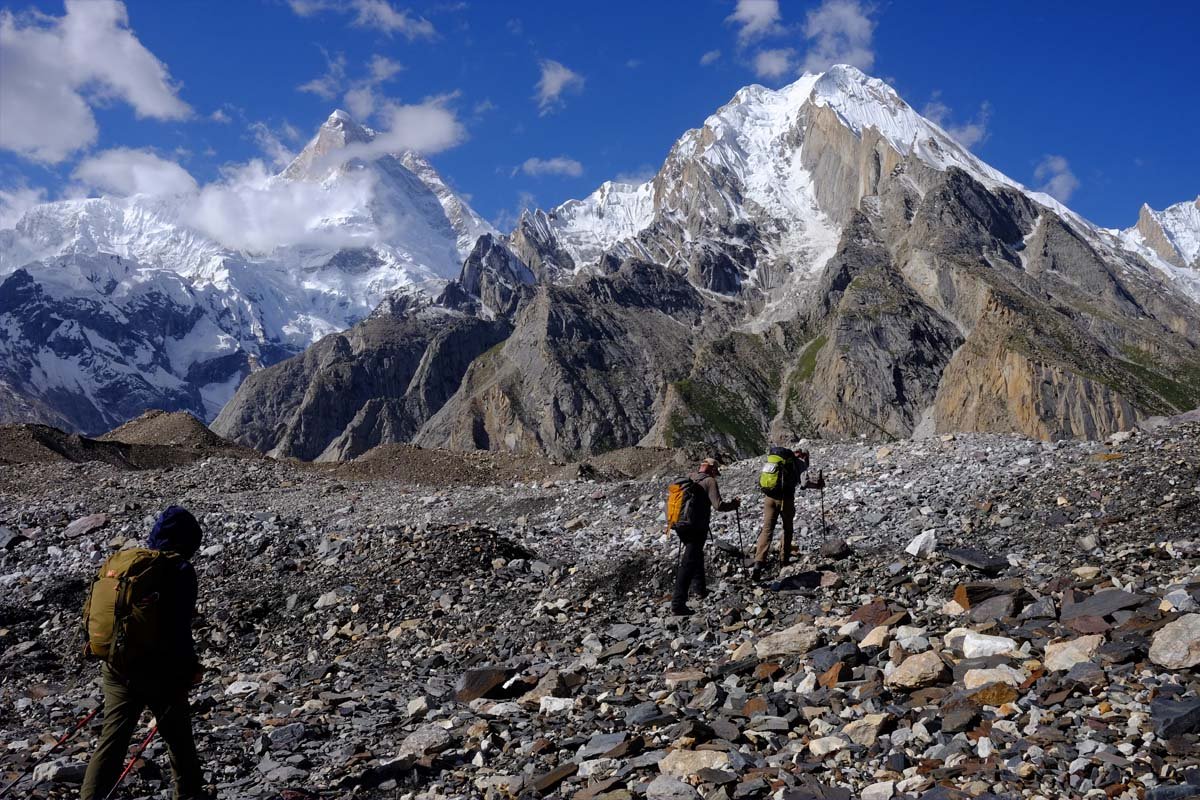
| 5–13 | Drive to Askoli, then the trek up the Baltoro Glacier via Paju, Urdukas, Goro II and Concordia to K2 Base Camp | Camps on the trek |
| 14–15 | Rest and acclimatisation | K2 Base Camp |
| 16–38 | Climbing period: rotations to the high camps, rest, the weather wait and the summit push | Base camp and the high camps |
| 39 | Spare day for the summit or the descent | K2 Base Camp |
| 40–46 | Walk out to Askoli and drive back to Skardu | Camps, then Skardu |
| 47–50 | Rest day, flight to Islamabad, debriefing, departure | Hotels in Skardu and Islamabad |
Climbers usually make two acclimatisation rotations before the summit push: first to Camp 1 and then to Camp 2 or higher, with rest at base camp in between. The exact plan is decided on the mountain by the guides and the climbers. The summit push itself takes about 4 to 6 days from base camp and back.
When is the best time to climb K2?
The best time is from 20 June to 5 August, and our fixed departures start on 20 June. Most summits come in the second half of July. For most of the year strong jet-stream winds blow over the Karakoram; in summer they move away for a short time, and that gap gives the summit window. In some years the window comes late, in August, and in some years there is none.
K2 was the last 8,000 m peak to be climbed in winter, on 16 January 2021. We also run private K2 expeditions in other seasons, at the same price.
Other routes on K2
- Abruzzi Spur (south-east ridge): the normal route, used for about three in four summits.
- Cesen or Basque route (south-south-east spur): the second route used by teams today. It joins the Abruzzi Spur high on the mountain, near the Shoulder.
- North Ridge: from the Chinese side, rarely climbed.
- Harder lines such as the Magic Line, the South Face and the West Face: climbed by very few teams, some never repeated.
How hard is K2? K2 compared with Everest
K2 is lower than Everest, but by most measures it is the harder mountain. Here is how the two compare:
| K2 | Everest | |
|---|---|---|
| Height | 8,611 m | 8,849 m |
| First ascent | 1954 | 1953 |
| First winter ascent | 2021 | 1980 |
| Terrain | Steep all the way, with rock, ice and the Bottleneck | Long, less steep sections (the Western Cwm on the south side) |
| Approach | About 8 days on foot up the Baltoro Glacier | About 8 to 10 days’ trek to base camp |
| Summits by mid-2022 | About 516 | More than 11,000 |
Figures for summits come from Alan Arnette’s records (2022). By mid-2022, before that summer’s season, K2 had about 516 summits and about 93 deaths, far more deaths for every summit than on Everest. K2 is lower, but it is steeper, its weather is harder to predict and its approach is longer, so it asks more of a climber.
Who can climb K2?
- You need to have climbed at least one 7,000 m peak.
- You must be at home on fixed ropes with a jumar and crampons at high altitude, and able to climb rock and mixed ground with heavy gloves.
- Train for months before you come, and test your gear on a 7,000 m peak first.
- Pack the right gear: see our K2 packing list (PDF).
Oxygen and fixed ropes
- Oxygen: most climbers on K2 use bottled oxygen high on the mountain. On our Full Board package you get 3 bottles, with a mask and regulator; when to start using oxygen is decided on the mountain by the guides and the climbers.
- Without oxygen: some climbers do it, but only with a lot of experience on other 8,000 m peaks without oxygen. It is much harder and riskier.
- Fixed ropes: the route is fixed with ropes from Advanced Base Camp to near the summit each season. On our Full Board package, a local rope-fixing team does this work, with Pakistani high-altitude porters.
A short history of K2
The name K2 comes from the Great Trigonometrical Survey of India: in 1856 the surveyor Thomas Montgomerie labelled the Karakoram peaks K1, K2 and so on, and the name stayed. In Balti, the language of Baltistan, K2 is called Chogori. After many attempts, K2 was first climbed on 31 July 1954 by Lino Lacedelli and Achille Compagnoni of an Italian expedition, by the Abruzzi Spur, with the help of Walter Bonatti and the Hunza high-altitude porter Amir Mahdi. The first winter ascent came on 16 January 2021.
Frequently asked questions
How long does it take to climb K2?
About 50 days from Islamabad back to Islamabad, of which about 25 days are on the mountain. Summit day itself takes 10 to 16 hours from Camp 4 and back.
How many camps are on K2?
Four high camps on the Abruzzi Spur, at about 6,050 m, 6,700 m, 7,200 m and 7,800 m (the Shoulder), above K2 Base Camp at about 5,150 m.
What is the Bottleneck on K2?
A narrow, steep couloir at about 8,200 m, between Camp 4 and the summit, directly below a large serac. It is followed by an exposed traverse to the summit slopes.
What is House’s Chimney?
A near-vertical rock crack of about 30 m just below Camp 2 (about 6,600 m), first climbed by Bill House in 1938. It is climbed on fixed ropes.
What is the best month to climb K2?
July. The best time is from 20 June to 5 August, and most summits come in the second half of July.
Is K2 harder than Everest?
Yes, by most measures. K2 is 238 m lower, but it is steeper from base camp to the summit, its weather is harder to predict and far more climbers have died for every summit.
Which route is used to climb K2?
Almost always the Abruzzi Spur. The Cesen route is the second option; it joins the Abruzzi Spur near the Shoulder.
Do climbers use oxygen on K2?
Most do, high on the mountain. Our Full Board package includes 3 bottles with a mask and regulator.
What experience do I need to climb K2?
At least one 7,000 m peak, and you must be at home on fixed ropes with a jumar and crampons at high altitude.
Can you climb K2 in winter?
Yes, but only very rarely. The first winter ascent was on 16 January 2021. Our fixed departures are in summer; we run private expeditions in other seasons too.
Who first climbed K2?
Lino Lacedelli and Achille Compagnoni, of an Italian expedition, on 31 July 1954, by the Abruzzi Spur.
Climb K2 with us
See the dates, both packages and the booking form on our K2 Climbing Expedition page, read how much it costs to climb K2, and check the K2 packing list (PDF) before you go. For everything else about K2, see our K2 hub.
About the author
Riaz Ahmed Shigri is the Logistics and Marketing Manager of Chogori Adventure, with extensive experience of trekking and expeditions in the Karakoram. Chogori Adventure is a local company from Skardu, founded in 2015 and licensed by the Department of Tourist Services (licence no. 2494) and the Gilgit-Baltistan tourism department (licence DTS-GB-055), with offices in Skardu and Islamabad.